
Clay vessels, archaeology, and antiquities
Click the Play Button to Listen to the Text
Clay vessels make up a significant portion of the artifacts uncovered during archeological excavations, because of the durability of fired clay. The manner in which vessels are removed from an archaeological site is critical to the preservation of the artifact and the knowledge it contains, and it is important that this is done professionally by archaeologists only.
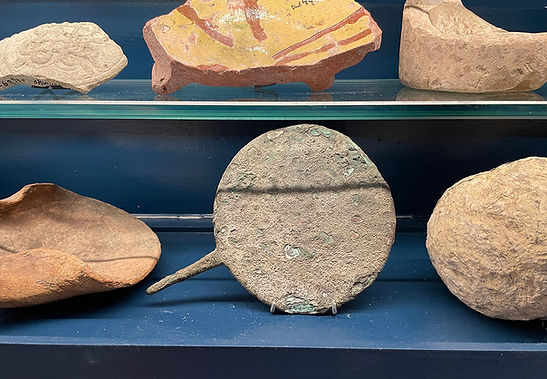
Many of the vessels in the collection at Beit Hankin were collected by local residents, on hikes or while working in the fields, during a period when people were not yet aware of the importance of organized collection and documentation, and therefore, many important details about these artifacts were lost.
Kfar Yehoshua was founded next to an ancient tel: Tel El-Shamam. In the moshav’s early days, farmers scattered the soil from the tel in their fields in order to improve the soil. Many of them later found archaeological artifacts in their fields.
Moshav resident Rina Porat relates:
“There was a tel, like many tels that exist in Israel, but in those times, nobody knew anything about archaeology or antiquities... There were many antiquities there... No one noticed... Afterward, people told me that residents of Kfar Yehoshua found a jug, for example, an intact jug - and they broke it. Maybe there are coins in the jug! They broke it and threw it out. (Laughs) [...] They thought that it was lightweight soil, and they needed to mix our heavy soil with the lightweight soil, so they would go there with wagons and fill up a wagon, and then come back to the orchard and scatter it. Then they’d go back and refill the wagon, and slowly, they lowered the entire tel. But if you excavate there, there are surely many more things to be found.”