
Skeletons in the Closet
Click the Play Button to Listen to the Text
Beit Hankin has a large collection of skeletons that were an important teaching tool in science classes. The skeletal system and bones are unique to the subphylum Vertebrata, which includes fish, amphibians, reptiles, birds, and mammals. The skeletons here represent the classes as they appeared according to evolution, from the earliest - fish, to the latest - mammals.
Skeleton of a common carp
Fish were the first organisms to develop a spine, 400 million years ago. The common carp is a fish that is commonly consumed, and it lives in fresh water. It originated in Asia and spread all over the world. In Israel, it is bred in fish ponds in the northern part of the country. It is known that this species was brought from Yugoslavia to Kibbutz Nir David, where the first commercial fish pond in Israel was built, and it was the source of all of the carp bred today in Israel.
Skeleton of a Levant water frog
Amphibians live in water when they are young and are capable of also existing on dry land when they are mature. The first amphibians developed 350 million years ago from ancient lungfish. Their ascent to dry land was made possible thanks to the development of four limbs and lungs that allowed them to breathe outside of the water. A unique characteristic of amphibians is the metamorphosis that they undergo. At the beginning of the process, the tadpole hatches from the egg, and only later does it develop its mature form (frog, toad, salamander, newt, etc.). The tadpole only lives in fresh water, and similar to a fish, it has fins, gills, and a tail for swimming. The Levant water frog is common in Israel and the eastern Mediterranean Sea, and it primarily lives in permanent, freshwater bodies of water such as rivers and springs that are full all year round.
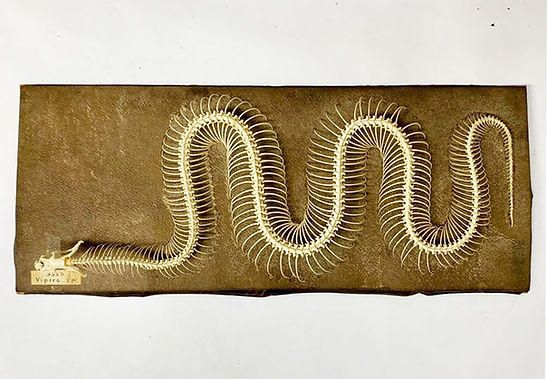
Skeleton of a Palestine viper
Ancient reptiles developed from amphibians about 300 million years ago, after they developed an egg with a shell that could be laid on dry land, and their bodies became covered with scales made of keratin, which protect them from dehydrating. Thanks to these traits, reptiles adapted to living entirely on dry land. The snake developed about 100 million years ago, it seems, from a certain species of lizard that gradually lost its legs.
Ancient snakes did not have venom, like lizards. Only later in evolution did some of them develop saliva glands that gradually developed into venom glands. It is important to emphasize that even today, most snakes are not poisonous, and in Israel, only 9 out of the 41 snake species are poisonous. Today, all snakes, like all vertebrates, are considered protected animals by law and killing them is prohibited.The Palestine viper is the most common poisonous snake in Israel, because the other poisonous snakes live mainly in deserts in the south. The viper is also a protected animal, and if one is found next to a home, a snake catcher should be called to catch and release it back to nature, in order to keep both sides safe.
Skeletons of mammals - the house cat and the Cape hare
Based on the shape of a mammal’s skull, it is relatively easy to differentiate between carnivores and herbivores. Notice that the hare has the teeth of a herbivorous animal - large front incisor teeth for cutting plants and gnawing on hard roots and branches. These teeth have an open root. While they are worn down by the gnawing, they continue to grow throughout the animal’s life. The cat’s largest teet are actually its cuspids, which function to pierce its prey and kill it quickly when it hunts.
The Cape hare is a wild species that is common in Israel in fields, orchards, and natural areas, and it is different than the European rabbit, which only lives in cages in petting zoos. The house cat, in contrast, is a species that was domesticated from the wildcat a few thousands years ago, and ever since, it has lived near humans all over the world, in millions, in homes and near residential areas. Today, the cat poses a real ecological threat, both to species of wild animals that it preys on, such as lizards, snakes, and songbirds, and to wild predators in nature, such as foxes, wildcats, and birds of prey, who it competes with for food.